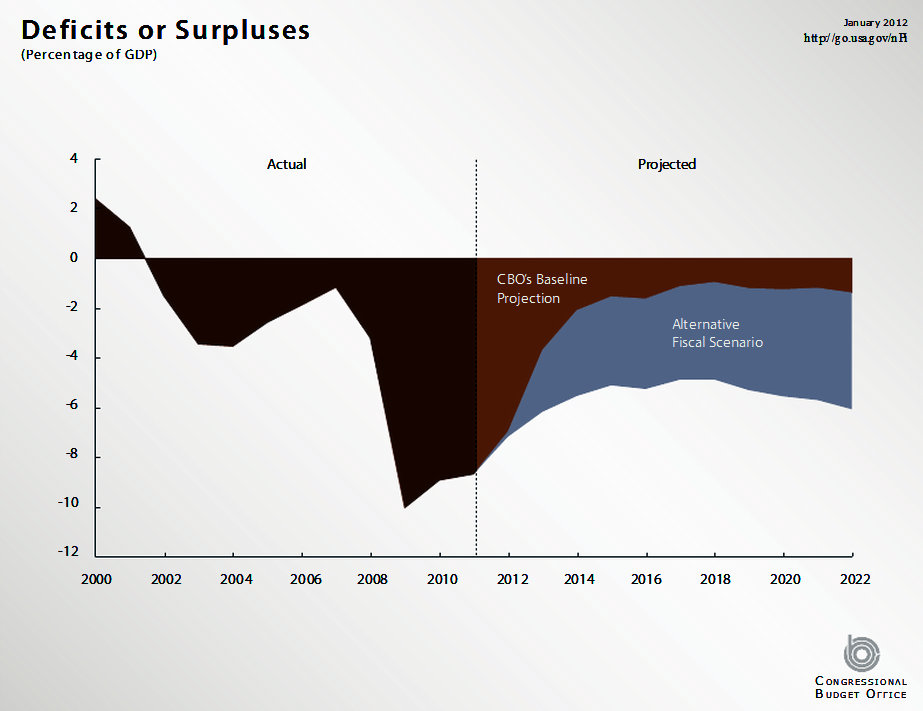
 The fiscal cliff pertains to a series of actions to be taken by the federal government in early 2013 in order to reduce the national budget deficit to almost half its current value. To clarify, the budget deficit refers to the amount of money which the government owes to its creditors within a specific period of time--it is not to be confused with the national debt which is applied to pay for the accumulation of deficit. So why should this reduction in deficit affect the average American? Well, among the most significant contributors to the deficit is government spending, which will be expected to decline with the advent of the fiscal cliff: this includes a reduction in spending for defense, federal agencies, and Cabinet departments (with major social programs such as Medicaid, Social Security, and veterans' benefits remaining exempt). Furthermore, a decline in budget deficit will result in tax increases, thereby offsetting the income tax cuts of the Bush Administration as well as the payroll tax cuts implemented by the Obama Administration.
With economic stability for the next year at stake, several political stances have developed potential solutions for the fiscal cliff. For example, the Democratic party has agreed to support the extension of Bush Administration tax cuts for the bottom 98% of the economy whilst allowing for tax cuts for the top 2%, as recently confirmed in a public statement. Additionally, President Obama has expressed support for spending cuts such as $1.6 trillion in tax increases over the next decade as well as $400 million of cuts to Medicare over the same time frame. On the other hand, the Republican party has proposed to mitigate the fiscal cliff by extending the Bush-implemented tax cuts (including those for the top 2%) and by cutting the national deficit by $2.2 trillion over the next decade by reducing tax and federal expenditures such as exemptions (charity donations, loopholes, etc.) and Medicare (by raising the eligibility age), respectively.
The average American deserves to know that the fiscal cliff is not a dramatic economic cataclysm but is nonetheless quite serious. The proposals offered to quell the effects of this reduction in deficit must go into effect by the end of 2012 in order to allow for desirable mitigation. With that in mind, Americans should watch carefully for the latest updates on this volatile subject.
-Chris Cattafi, Co-Founder and Vice President of Investment Club